
Braille Signs, Mounting Heights, and More: ADA Signage Rules Most Businesses Miss

ADA signage rules often feel straightforward on the surface — install compliant signs, add Braille where required, and follow posted height guidelines. In reality, many businesses in Schaumburg, Illinois and across the greater Chicagoland area overlook small but critical details that can lead to accessibility issues, failed inspections, or costly rework. From mounting heights that are off by just a few inches to incorrect tactile lettering placement, these “minor” mistakes can create major compliance problems.
For commercial properties in Schaumburg, Illinois and throughout the Chicago, Illinois metro area, ADA signage compliance isn’t just about checking a box — it’s about ensuring equal access and clear navigation for every visitor. Requirements for Braille signage, visual contrast, font selection, and installation height are highly specific, and they’re frequently updated or misinterpreted during design and buildouts.
In this blog, we’ll break down the most commonly missed ADA signage rules, including Braille requirements, mounting heights, and placement standards. Whether you manage a retail space, office building, or healthcare facility, understanding these details can help you stay compliant, avoid penalties, and create a more accessible environment for everyone.

Understanding ADA Signage Requirements
The Americans with Disabilities Act (ADA) Standards for Accessible Design establish clear requirements to ensure that people with disabilities can navigate public and commercial spaces safely and independently. Within these standards, signage plays a surprisingly important role. It’s not just about labeling rooms, it’s about creating a consistent, accessible wayfinding system that supports equal access for everyone.
At its core, ADA signage is designed to help individuals who are blind, have low vision, or have other disabilities identify spaces, understand building layouts, and move through a facility without confusion or barriers. Signs must be thoughtfully designed, properly placed, and easy to interpret both visually and tactilely. In busy commercial environments across Schaumburg and the greater Chicagoland area, this becomes especially important where high foot traffic and complex building layouts can make navigation more challenging.
ADA-compliant signage generally falls into several key categories:
• Room identification signs: These signs are required for permanent spaces such as offices, conference rooms, storage areas, and restrooms.
• Exit signs and directional signage: These signs help guide occupants safely during both everyday use and emergencies.
• Restroom signage: This signage must meet strict requirements for tactile lettering and Braille.
• Directional signs: These signs are essential for guiding visitors through lobbies, hallways, and multi-tenant spaces where clear navigation is critical.
Responsibility for ADA signage compliance is often shared among multiple parties, which is where confusion frequently arises. Property owners are typically responsible for ensuring the building meets baseline accessibility standards. However, tenants may also be responsible for signage within their leased space, especially when it comes to interior room identification. Landlords, contractors, architects, and designers all play a role during construction or renovation projects, and miscommunication between these parties is one of the most common reasons compliance issues occur.
Understanding these basics is the first step toward avoiding costly mistakes and ensuring that signage throughout a facility is both legally compliant and genuinely accessible.
Braille Signage Rules Businesses Commonly Get Wrong
Braille signage is one of the most misunderstood parts of ADA compliance, and it’s also one of the most frequently inspected. While many businesses in Schaumburg and the wider Chicagoland area assume that “adding Braille” is enough, the ADA Standards are very specific about when it is required, where it must be placed, and how it must be produced.
• Not required on every sign: Braille is generally required on permanent room identification signs such as offices, conference rooms, restrooms, storage rooms, and similar spaces. However, it is not typically required on temporary signs, directories, or informational signage that does not identify a fixed room or space. This distinction is important, because over-applying or under-applying Braille can both lead to compliance issues during inspections or accessibility audits.
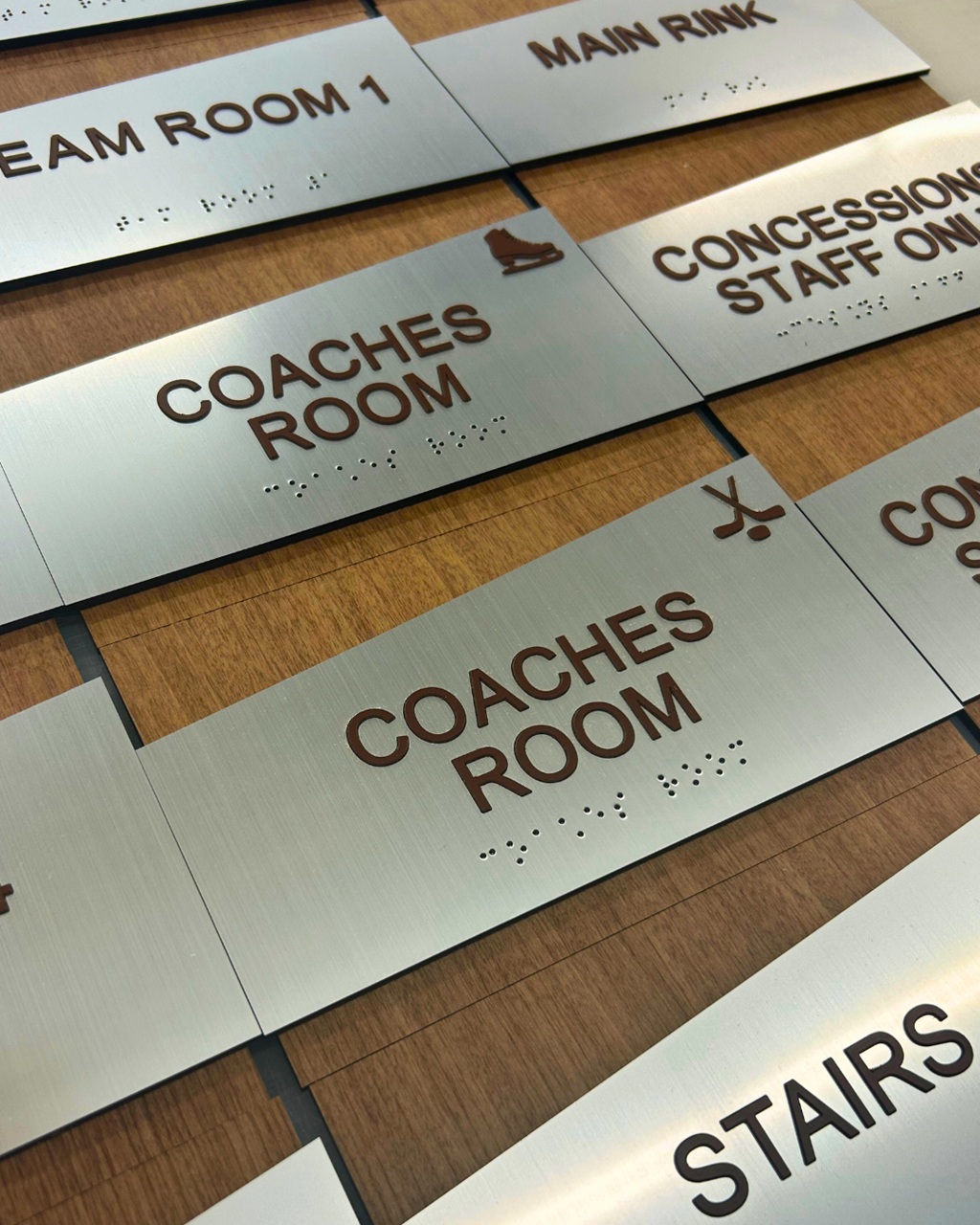
• Placement is critical: Braille must be positioned directly below the corresponding tactile (raised) text and aligned left-to-right with the characters above it. Even slight misalignment can make the sign difficult to read for Braille users and may cause the sign to fail compliance review. Proper spacing between Braille cells and clear separation from raised text are also essential to ensure readability.
• Manufacturing and installation mistakes: Common issues include incorrect Braille dot height, inconsistent cell spacing, or engraving that is too shallow or too deep. Low-quality production methods can make Braille difficult or even impossible to read by touch, defeating its entire purpose. In some cases, signs may look compliant visually but fail ADA standards when measured or tested.
• Difference between Grade 1 and Grade 2 Braille: ADA-compliant signage uses Grade 2 Braille, which includes contractions and is the standard for public use in the United States. Grade 1 Braille, which spells out words letter by letter, is not acceptable for most permanent signage applications. Using the wrong grade can immediately render signage non-compliant, even if everything else is correct.
Ultimately, poorly executed Braille signage doesn’t just create a technical violation, it creates a real barrier for accessibility. If the dots are inconsistent, improperly placed, or difficult to distinguish by touch, the sign fails its purpose entirely. In commercial spaces where compliance is expected and accessibility is required, these details matter far more than many businesses initially realize.
Mounting Heights and Placement Standards
Even when signage is properly designed and manufactured, incorrect installation can quickly make it non-compliant. Mounting height and placement are some of the most commonly cited ADA signage issues in commercial properties throughout Schaumburg and the greater Chicagoland area, largely because the rules are very specific and easy to get wrong during fast-paced construction or tenant buildouts.
• Height range: Under ADA Standards, tactile signs must be installed within a defined height range, so they are consistently reachable and readable. In most cases, the baseline of the raised characters must be mounted at a height between 48 inches and 60 inches above the finished floor. This range is designed to ensure accessibility for a wide range of users, including individuals who use wheelchairs. Even small deviations outside this range can result in a failed inspection or required reinstallation.
• How height is measured: The ADA does not measure from the top or center of the sign, it specifically requires measurement from the finished floor surface to the baseline of the raised tactile characters. This distinction matters, especially when flooring materials change during construction or when signs are installed before final flooring is completed. Failing to account for this can result in signs being installed too high or too low once the project is finished.
• Placement relative to doors: ADA-compliant signs must typically be mounted on the latch side of the door, not centered or placed on the door itself. This ensures that users can locate and read the sign before reaching the door handle. A common error in commercial spaces is placing signage directly above door frames or in visually “balanced” positions that do not meet accessibility requirements. While these placements may look aesthetically pleasing, they often fail compliance standards.
• Installation challenges: Wall materials such as glass, textured surfaces, or uneven finishes can affect how securely and accurately signs are mounted. Door hardware, trim, and adjacent fixtures can also interfere with proper placement, forcing installers to make adjustments that may unintentionally violate ADA spacing rules. In retrofit projects, especially in older buildings across Chicagoland, these issues become even more common.
Ultimately, proper mounting height and placement require more than just following a measurement, they require coordination between design intent and on-site conditions. When these details are overlooked, even high-quality ADA signage can fail to meet compliance standards once installed.
Visual and Tactile Design Requirements
ADA signage isn’t just about where signs are placed, it’s also about how they look and feel. The visual and tactile design requirements are highly specific, and they’re often where businesses in Schaumburg and across Chicagoland unintentionally run into compliance issues, especially when prioritizing branding or interior design over accessibility standards.
• Typography: ADA standards require the use of clear, simple sans-serif fonts. Decorative, script, italicized, or overly stylized fonts are not permitted for tactile or visual characters on compliant signage. The reason is straightforward: readability. Complex font styles may look attractive in a branded environment, but they can be difficult to distinguish quickly, especially for individuals with low vision or cognitive disabilities.
• Color contrast: There must be sufficient contrast between the text (or symbols) and the background to ensure visibility. For example, light gray text on a white background or low-contrast color pairings can fail ADA standards even if the signage is otherwise well-designed. High contrast combinations, such as dark text on a light background, are typically necessary to meet compliance and improve overall legibility in a variety of lighting conditions.
• Finish and surface texture: ADA-compliant signage must have a non-glare or matte finish to reduce reflections that can interfere with readability. Glossy or reflective surfaces may look modern, but they can create visibility issues in brightly lit environments like office lobbies, hospitals, or retail spaces. This is especially important in buildings with large windows or strong overhead lighting, where glare can significantly reduce sign clarity.
• Tactile elements: Raised characters need to be uniform in height, properly spaced, and proportioned to ensure they can be read by touch. If characters are too thin, too close together, or inconsistently formed, the sign may fail both usability expectations and formal ADA requirements. Even minor deviations in manufacturing can affect how easily the information can be interpreted by touch.
• Signage design: Businesses frequently want signage that aligns with modern branding, minimalist layouts, unique fonts, or artistic elements. While these design choices may enhance a visual identity, they can easily conflict with ADA requirements. In many cases, signs that look visually appealing in a design mockup are later found to be non-compliant once ADA rules are applied.
Balancing aesthetics with accessibility is possible, but it requires careful planning from the start. When visual design takes priority over compliance, businesses often end up redoing signage entirely, adding unexpected costs and delays that could have been avoided with ADA standards in mind from the beginning.

Common ADA Signage Violations Found in Chicagoland Businesses
Even when businesses intend to follow ADA guidelines, real-world conditions often lead to mistakes. Across Schaumburg and the surrounding Chicago suburbs, ADA signage violations are frequently discovered during inspections, renovations, and tenant improvements, often when it’s already costly or time-consuming to fix them.
• Inconsistent compliance across different parts of the same building: For example, a newly renovated office suite may have fully compliant signage, while older common areas or secondary corridors still use outdated or incorrectly installed signs. This patchwork approach is especially common in multi-tenant commercial properties where updates are made gradually rather than all at once.
• Renovations, tenant buildouts, and rebranding projects: During these projects, signage is often treated as a finishing detail rather than a regulated requirement. As a result, contractors may install signs based on aesthetics or general placement habits rather than ADA specifications. Even small oversights like mounting a sign a few inches too high or using non-compliant typography can create violations that are flagged during inspection.
• Spaces are repurposed without updating signage: A storage room converted into an office, or a conference room rebranded as a private workspace, may still retain its original signage, or worse, lack proper identification entirely. When room functions change, ADA-compliant signage must be updated to reflect the new use of the space, but this step is often overlooked during fast-moving renovations.
• Inspection and permitting challenges: Building inspectors in the Chicagoland area routinely check for ADA signage compliance as part of occupancy approvals and renovation sign-offs. Non-compliant signage can delay final approvals, require reinstallation, or even result in partial project hold-ups until corrections are made. This is especially common when signage was installed without coordination between designers, contractors, and accessibility standards early in the project.
Most ADA signage violations are not the result of negligence, but rather fragmented planning and lack of coordination. When accessibility requirements are not built into the process from the beginning, even well-designed spaces can fall short of compliance once they are reviewed in detail.
Industry-Specific Signage Considerations
ADA signage requirements apply across all commercial spaces, but how they are implemented can vary significantly depending on the type of facility. In Schaumburg and throughout the Chicagoland area, different industries face unique challenges based on building layout, traffic flow, and how visitors interact with the space.
• Office buildings and corporate campuses: Signage in these environments often needs to balance professionalism with strict compliance. Multi-floor layouts, shared conference rooms, and tenant-specific suites require clear room identification and consistent placement standards. One of the most common issues in these environments is inconsistent signage between tenants or floors, especially when spaces are built out at different times or by different contractors.
• Retail and shopping centers: Ensuring signage is in compliance in these settings is challenging due to high foot traffic and constantly changing store layouts. Directional signage is especially important here, helping customers navigate restrooms, exits, and store directories. However, frequent tenant turnover can lead to outdated signage, missing updates, or mismatched branding that does not meet ADA requirements. Mall environments also often struggle with maintaining consistent placement standards across multiple storefronts.
• Healthcare facilities and hospitals: These environments have some of the most stringent expectations for ADA signage because accessibility directly impacts patient care. Clear identification of exam rooms, departments, restrooms, and emergency exits is critical. In these environments, even minor signage errors can create confusion for patients and visitors who may already be under stress or mobility limitations. As a result, healthcare signage typically requires a higher level of consistency and durability.
• Restaurants and hospitality spaces: Signage in these spaces must support both guest experience and regulatory compliance. Restroom signage, exit routes, and accessible room identification are key areas where ADA standards apply. A common issue in this industry is prioritizing interior design aesthetics over accessibility requirements, which can lead to non-compliant decorative signage that fails inspection despite looking visually appealing.
• Industrial and warehouse environments: While these spaces may seem more utilitarian, ADA signage is still required in applicable public or employee-access areas such as offices, break rooms, and restrooms. Challenges often arise when signage is installed in fast-paced environments where functionality is prioritized over precision, leading to incorrect mounting heights or missing tactile elements.
Across all industries, the core challenge remains the same: ensuring that ADA signage is not treated as an afterthought. Each environment has different operational needs, but compliance standards remain consistent and overlooking them can lead to costly corrections regardless of the industry.

The Cost of Non-Compliance
ADA signage violations may seem like small technical issues, but the consequences of getting them wrong can add up quickly. For businesses in Schaumburg and across the Chicagoland area, non-compliance can lead to financial penalties, project delays, and long-term reputational damage that far outweigh the cost of getting signage right the first time.
• Legal exposure under ADA regulations: Businesses that fail to meet accessibility requirements may face complaints, investigations, or lawsuits. Even when cases don’t escalate to court, resolving accessibility issues can involve legal fees, mandated corrections, and compliance agreements. In some situations, repeated violations or failure to address known issues can increase liability and enforcement pressure.
• Delay occupancy permits and final inspections: In commercial construction and tenant buildouts, ADA compliance is often reviewed as part of the approval process. If signage is missing, improperly installed, or incorrectly designed, inspectors may require corrections before a space can be officially opened or occupied. These delays can disrupt business timelines, push back launch dates, and increase overall project costs.
• Cost of rework: When signage is installed incorrectly, whether due to wrong mounting heights, improper Braille, or non-compliant design, it typically cannot be “fixed” in place. Instead, it must be removed and replaced entirely. This means paying twice for design, fabrication, and installation, along with additional labor costs and potential repair work to walls or finishes.
• Impact on customer experience and brand reputation: Poor or missing ADA signage creates barriers for visitors who rely on accessible navigation, leading to frustration and a negative impression of the business. In competitive markets like Chicagoland, where customers have many options, accessibility is increasingly seen as part of overall service quality. A lack of attention to ADA compliance can subtly signal disorganization or a lack of care for customer needs.
The cost of non-compliance extends far beyond signage itself. It affects timelines, budgets, legal standing, and how a business is perceived. Investing in proper ADA signage from the start is almost always more efficient and far less expensive than correcting mistakes after the fact.
Best Practices for ADA-Compliant Signage Installation
Getting ADA signage right isn’t just about understanding the rules, it’s about building a process that ensures compliance from design through installation. For businesses in Schaumburg and across the Chicagoland area, following a few key best practices can prevent costly mistakes and help ensure every sign is properly placed, readable, and fully compliant.
• Work with experienced ADA signage providers: Specialists who understand ADA Standards for Accessible Design can help translate complex regulations into practical solutions, ensuring that signage is both compliant and appropriate for the specific building type. This expertise is especially valuable in commercial environments where multiple tenants, renovations, or phased buildouts can complicate installation.
• Conduct pre-installation compliance reviews: Before any signage is installed, layouts should be reviewed against ADA requirements for height, placement, Braille, and visual design. Catching issues at this stage is far easier and less expensive than correcting mistakes after installation. This review process helps identify conflicts with doors, hardware, or architectural features that could affect proper placement.
• Use standardized mounting templates and measurements: Templates ensure that every sign is installed at the correct height and position, even when multiple installers or contractors are involved. This is particularly useful in larger projects such as office buildings, retail centers, or healthcare facilities where consistency across many rooms is essential.
• Coordination early in the construction or renovation process: ADA signage should not be treated as a final-step detail. Instead, it should be integrated into architectural plans and construction schedules from the beginning. Early coordination allows designers, contractors, and property managers to align placement requirements before walls are finished or fixtures are installed, reducing the risk of last-minute adjustments.
• Documentation and verification before final inspection: Keeping records of signage specifications, installation locations, and compliance checks helps streamline the approval process and provides proof that ADA requirements have been met. This step is especially useful when working with building inspectors or preparing for occupancy approvals in regulated commercial spaces.
When these best practices are followed together, ADA signage becomes a seamless part of the building process rather than a last-minute correction. The result is a safer, more accessible environment, and far fewer surprises during inspection or occupancy review.

Getting ADA Signage Right the First Time with Divine Signs and Graphics
ADA signage compliance is one of those areas where the smallest details make the biggest difference. From Braille placement and mounting height to font choice and material finish, every element plays a role in creating a space that is not only compliant but also truly accessible. In busy commercial environments across Schaumburg and the greater Chicagoland area, these details are often the difference between a smooth inspection and costly rework.
The good news is that ADA signage doesn’t have to be complicated when it’s handled correctly from the start. With the right planning, materials, and installation approach, businesses can meet federal requirements while still maintaining a clean, professional, and cohesive design throughout their space.
For businesses looking to ensure their signage is fully compliant and professionally installed, it is best to work with an experienced specialist. Divine Signs and Graphics provides custom ADA-compliant signage solutions designed to meet regulatory standards while supporting the look and functionality of your space. From design and fabrication to precise installation, our team helps businesses avoid common compliance pitfalls and ensure every sign is correctly placed and properly executed.
Whether you’re planning a new buildout, renovating an existing space, or updating outdated signage, investing in expert ADA signage support can help you stay compliant, avoid delays, and create a more accessible environment for everyone who walks through your doors.
Let Us Get Started with your next big idea...

